Energy Market Overview: In July, Estonia’s Electricity Price Remained Significantly Lower than in Latvia and Lithuania
July brought considerably lower electricity prices to consumers in Estonia. The average electricity price settled at 4.4 cents per kilowatt-hour, approximately 32% lower than in June. Compared to July 2025, however, the price remained around 20% higher. Estonia’s electricity price was once again substantially lower than in Latvia and Lithuania, where monthly average prices reached 7.5 and 7.6 cents per kilowatt-hour, respectively.
The main reason for Estonia’s lower price level compared to its southern neighbours was its better access to inexpensive Finnish electricity. Finland’s average electricity price fell to just 1.5 cents per kilowatt-hour in July, while electricity imports from Finland into the Baltic region reached 531 GWh. At the same time, constraints on the Estonia-Latvia interconnection limited the flow of cheaper electricity further south, allowing a larger share of Finland’s low-priced electricity to remain in Estonia.
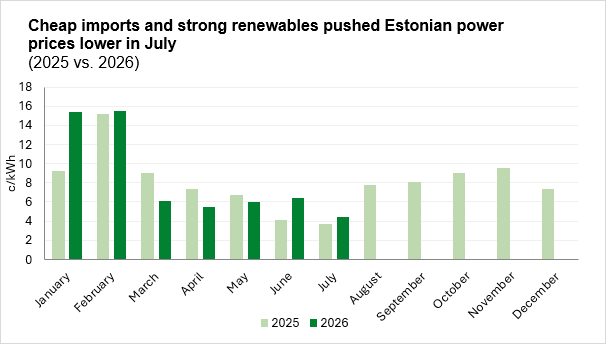
Estonia Continued as a Net Importer of Electricity
Estonian electricity demand reached 540 GWh in July, approximately 7% lower than during the same month a year earlier. Domestic electricity generation amounted to around 322 GWh, covering roughly 60% of total consumption.
As a result, Estonia remained a significant net importer of electricity in July. Net imports reached 221 GWh, 13% higher than in June but lower than in July last year. This continues the trend established in recent years, where Estonia relies on imports to cover a substantial share of its electricity demand. The availability of lower-cost imported electricity also reduced the need to operate higher-cost domestic dispatchable generation units.
Renewable Energy Accounted for a Large Share of Domestic Generation
Renewable energy’s contribution to Estonia’s electricity generation increased significantly in July. Solar generation reached approximately 145 GWh, while wind generation amounted to around 78 GWh, an increase of roughly 30% compared to June. Together, solar and wind accounted for close to 70% of all electricity generated in Estonia.
Solar power played a particularly important role during daytime hours, when high output reduced both import requirements and the need to operate more expensive thermal power plants.
At the same time, oil-shale generation declined to approximately 11 GWh, illustrating its diminishing role during summer periods when renewable output is strong and imported electricity remains inexpensive.
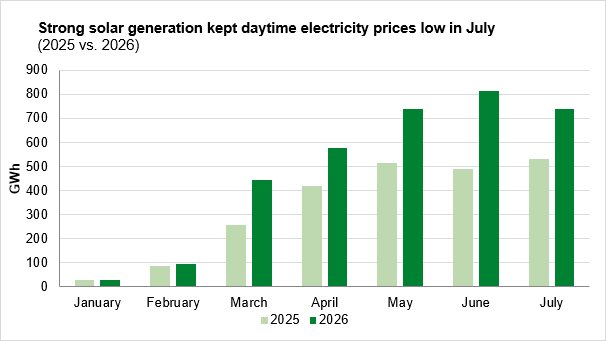
Large Price Fluctuations Persist During the Summer
Although the monthly average electricity price remained low, prices varied considerably throughout July. Estonia’s hourly electricity price ranged from slightly below zero to 25.7 cents per kilowatt-hour. During approximately half of all hours, prices remained below 2 cents per kilowatt-hour.
Low and occasionally even negative prices occurred primarily during periods when large volumes of solar and wind generation were available simultaneously, while inexpensive electricity was also imported from Finland. In contrast, prices increased during periods of weaker renewable generation, particularly during morning and evening hours when solar production was unavailable.
Nevertheless, Estonia remained in a substantially lower-priced bidding area than Latvia and Lithuania for most of the month.
August Prices Will Increasingly Depend on Wind Generation
Based on historical trends and normal market seasonality, electricity prices in Estonia are expected to rise somewhat in August. Solar generation will continue to support low daytime prices, but its impact will gradually weaken as daylight hours become shorter.
As a result, electricity prices will become increasingly dependent on wind generation in Estonia and Finland, the availability of imports through the EstLink interconnections, and the need for domestic generation during periods of low solar output.
Constraints between Estonia and Latvia are also expected to continue through August, leaving a larger share of cheaper Finnish electricity in the Estonian market. As a result, Estonia’s price level is likely to remain below that of Latvia and Lithuania. On a day-to-day basis, however, price developments will continue to depend heavily on weather conditions.
Karl Joosep Randveer, Senior Market Analyst at Enefit
The market overview has been compiled by Enefit according to the best current knowledge. The information provided is based on public information. The market overview is presented as informative material and not as a promise, proposal or official forecast by Enefit. Due to rapid changes in the regulation of the electricity market, the market overview or the information contained in it is not final and may not correspond to future situations. Enefit is not liable for any costs or damages that may arise in connection with the use of the information provided.