Real‑time electricity exchange prices
Estonia operates in the Nord Pool electricity market
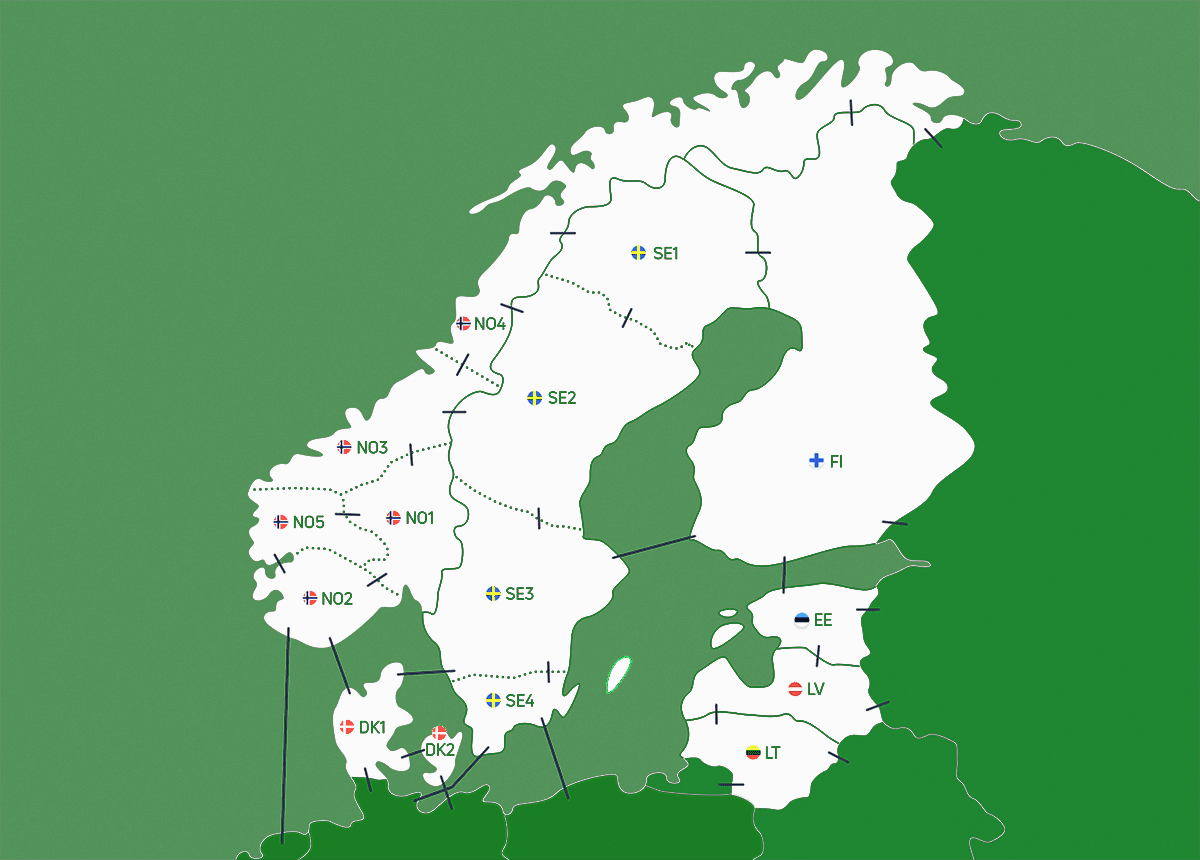
- Estonia is part of Nord Pool's open electricity market together with Norway, Sweden, Finland, Denmark, Latvia and Lithuania (see map).
- In the open electricity market (power exchange), the price of electricity is formed as a result of supply and demand.
- There is at least one price area in each country, in a larger country there may be several.
- The areas are connected by cables (dark blue lines on the map).
- Electricity prices vary from area to area due to limited cross-border transmission capacities.
- The more renewable energy an area produces, the cheaper the price of electricity there.
NB! Daily price fluctuations on the power exchange only affect those consumers with an electricity package based on exchange prices. In the case of a fixed price electricity contract, the price has been agreed for the contract period and will not change.
Exchange price of electricity
The exchange price of electricity changes every 15 minutes as a result of supply and demand.
Exchange price formation
- Electricity sellers place orders with the power exchange every day for how much electricity their customers will need for the next day. The amount of energy to be produced becomes clear.
- Renewable and nuclear units are the first to enter the market to meet demand. Their output is at a lower price because the energy sources are very cheap and no carbon dioxide is emitted. If there is enough renewable energy to cover the consumption, the price of electricity on the market will be affordable.
- If renewables do not meet the demand, oil shale, coal and gas power plants will have access to the market. Their electricity is more expensive due to both the fuel and the CO₂ emission charges.
- The exchange price of electricity is determined by the last bidder. If, for example, an expensive gas-fired power plant is the last to cover the market demand, it will determine the price of electricity for that particular 15-minute interval.

Average exchange prices
| Price | |
|---|---|
| August 2026 | 7.29 |
| July 2026 | 5.46 |
| June 2026 | 7.99 |
| May 2026 | 7.46 |
| April 2026 | 6.76 |
| March 2026 | 7.61 |
| February 2026 | 19.17 |
| January 2026 | 19.15 |
| December 2025 | 9.12 |
| November 2025 | 11.90 |
| October 2025 | 11.13 |
| September 2025 | 10.07 |
Prices cent/kWh. Sales marginal is added to prices.
Stock exchange
Nord Pool
Electricity exchange prices
If you have a remote reading meter installed at your consumption point, the point of consumption has been switched to remote reading, and you have selected the 15-minute interval rate Exchange package, your electricity bill will depend on how much electricity you consume every 15 minutes and the exchange price for that interval. Wholesale market prices for 15-minute intervals are published on the Nordic Power Exchange — that is, on the Nord Pool website. You can also check the 15-minute interval rates for the next day using Enefit’s mobile app.
Electricity prices in the wholesale market
On the wholesale market, very large quantities of electricity are traded on, thus, prices are expressed in megawatt hours (1 MWh = 1000 kWH). For example, if the wholesale price of electricity is EUR 43 per megawatt-hour, that would be 4.3 cents per kilowatt-hour in kilowatts. It is worth remembering that the wholesale price of electricity does not include VAT and does not take into account the customer's electricity consumption.
Effect of exchange prices on the invoice
If you have selected the Fixed package, the price per kilowatt-hour of electricity remains unchanged for an agreed period, and your monthly electricity bill will be the same. If your point of consumption has been switched to remote reading and you have selected a 15-minute interval rate Variable package, the amount of your electricity bill will depend on the amount of electricity consumed during each 15-minute interval and the exchange price for that interval.
Nord Pool Spot time zone
Important! The common Nordic electricity market, Nord Pool, operates in the Central European Time Zone (CET), which is one hour behind local Estonian time. To correctly calculate the electricity bill, Nord Pool Spot’s 15-minute interval prices must be shifted one hour forward to reflect electricity consumption in the Estonian time zone.