Energy Market Overview: Estonia’s Electricity Price Increased in August Due to More Expensive Imported Electricity
While the end of August typically brings the first signs of autumn to the energy markets, this past August still showed no indication that summer was coming to an end. Solar generation continued to account for a significant share of the energy consumed across the Baltics, while wind availability and import conditions primarily shaped prices during evening hours.
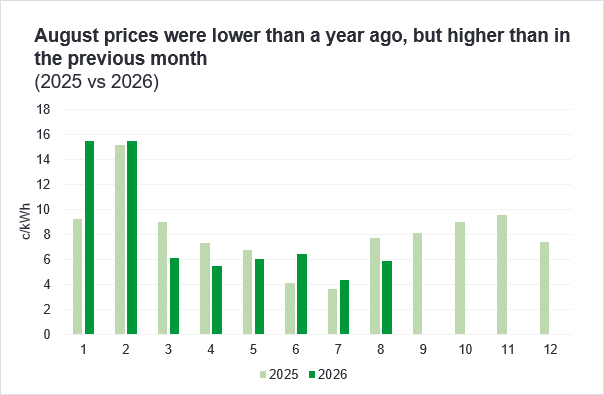
The average wholesale electricity price in Estonia was 5.9 cents/kWh, approximately one-third higher than in July (4.4 cents/kWh), but more than one-fifth lower than in August 2025 (7.7 cents/kWh). In Latvia and Lithuania, the average price was 8.0 cents/kWh.
Compared to July, the August price increase was mainly driven by local production dynamics and higher prices in Finland, where the average electricity price reached 4.1 cents/kWh (vs. 1.5 cents/kWh in July). As imported electricity accounted for roughly one-third of Estonia’s consumption, the increase in Finnish prices was partially passed through to Estonia.
Solar and wind generation reached record levels, but prices were still not lower – why?
This summer, the Baltics recorded the highest ever levels of solar and wind generation. From June to August, the region produced slightly above 3.6 TWh of solar and wind energy, 43.0% more than in 2025 (2.5 TWh). Approximately three-quarters of the increase came from solar generation.
Lithuania’s solar output increased by 56.4%, while Latvia recorded the strongest relative growth, with solar generation more than doubling year on year. Estonia, on the other hand, saw a more modest increase of 3.4%. Growth in wind generation was also driven primarily by Lithuania, where output increased by 26.9%.
Despite the strong growth in renewable energy generation, the average Baltic electricity price during the summer months (June to August) was approximately 34.0% higher than a year earlier, rising from 5.5 cents/kWh to 7.4 cents/kWh.
The main reason lies in capacity restrictions on the Estonia-Latvia interconnection. As transmission capacity was reduced by more than half during certain periods, cheaper Finnish electricity remained in Estonia in larger volumes. As a result, less low-priced Nordic electricity reached Latvia and Lithuania, contributing to higher price levels in those markets.
Another reason was the decline in Baltic hydropower production. While local hydropower covered nearly 18% of Baltic demand during the summer of 2025, this year the figure was only 6%. Last summer, the Baltics produced 86% more hydropower, which helped significantly reduce evening peak prices.
Global commodity markets point to higher regional prices
As a result of the Iran war, global gas prices are 130% higher than a year ago. Supply disruptions have removed a large share of Qatari LNG supply from the market at a time when European gas storage levels are already low.
Natural gas continues to play an important role in the European power market because gas-fired power plants often set the marginal price during hours when lower-cost generation is insufficient. As a result, gas prices affect electricity prices in Estonia even though relatively little electricity is generated from gas domestically. The more expensive natural gas becomes, or the tighter the gas market is, the greater the likelihood that higher costs will be reflected in wholesale electricity prices.
In addition, CO₂ allowance prices have increased. This translates into higher production costs for fossil fuel-based power plants and, consequently, higher peak electricity prices.
The situation is further complicated by exceptionally low hydro reservoir levels in the Nordics. For example, Norwegian reservoirs are entering the autumn season at their lowest level in 30 years. Without an exceptionally rainy autumn, there is a high probability that Nordic electricity prices will increasingly match the higher price levels seen in continental Europe.
As a consequence, higher Nordic electricity prices may spill over into the Baltics during Q4 and the winter months. The overall electricity price outlook remains heavily dependent on weather conditions, especially wind availability, autumn rainfall and winter temperatures, but due to the factors outlined above, the upside price risk is clearly higher than it was a year ago.
Karl Joosep Randveer, Senior Market Analyst at Enefit
The market overview has been compiled by Enefit according to the best current knowledge. The information provided is based on public information. The market overview is presented as informative material and not as a promise, proposal or official forecast by Enefit. Due to rapid changes in the regulation of the electricity market, the market overview or the information contained in it is not final and may not correspond to future situations. Enefit is not liable for any costs or damages that may arise in connection with the use of the information provided.