Overview of the energy market: electricity prices in August followed a familiar pattern
- Maintenance at Nordic nuclear power plants and low wind power generation pushed up electricity prices in Finland and Sweden. High dependence on more expensive imported electricity increased the Baltic average electricity price to 7.92 euro cents per kilowatt-hour (7.73 in Estonia, 8.03 in Latvia and 8.01 in Lithuania).
- Local renewable energy generation was weaker than in July. Solar power output in the Baltics amounted to 386 GWh, down 18% compared with July and 6% compared with August last year. Wind power generation, by contrast, increased to 283 GWh, which is 10% higher than in July and 19% higher than in August last year. Hydropower generation also declined during the month, which meant that evening hours relied more heavily on imports and fossil-based generation, resulting in higher prices.
- Renewable energy and imports covered demand during most hours, which reduced fossil fuel generation in the Baltics to 162 GWh in August, accounting for only 8.2% of demand. This is approximately 43% less than last year and three times lower than the average of the last five years.
In August, solar power generation decreased and several nuclear power plants in Scandinavia underwent scheduled maintenance, which also significantly increased the electricity price in the Baltics. At the same time, it can be seen that developments in the market have also brought about a change in the electricity price. In August, the average exchange price in Estonia was 7.73 c/kWh, in Latvia 8.03 c/kWh and in Lithuania 8.01 c/kWh. The Baltic average price was 7.92 c/kWh, almost twice as high as in July, but still the lowest in the past four years.
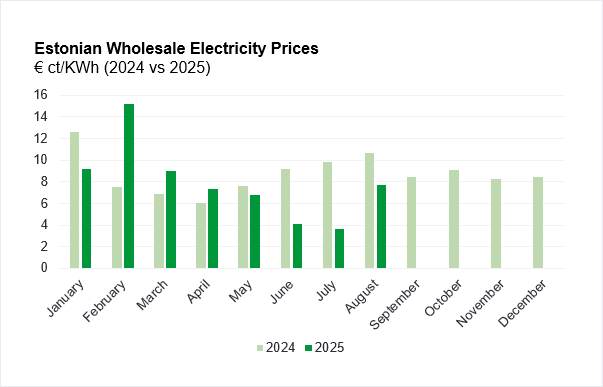
Maintenance at Finland’s nuclear power plant and low wind drove up import prices
One of the main reasons for the price increase was more expensive imports from Finland, where scheduled maintenance at nuclear power plants and low wind conditions more than doubled the market price of electricity compared with July. As the Baltics heavily depend on imported electricity transmitted via Estlink, the higher prices on the Finnish market were reflected in the prices in Estonia and across the Baltics. At the beginning of the month, electricity imported from Scandinavia through Estonia and Lithuania was cheaper, and local renewable energy generation was also stronger. This also kept electricity prices relatively low. In the second half of the month, however, prices rose as renewable energy generation declined in Scandinavia and the Baltics.
In Sweden and Finland, scheduled nuclear power plant maintenance usually lasts from the end of August until mid-September. When the plants return to the market and wind conditions normalise, the price of electricity imported from Scandinavia should fall again. At the same time, it is important to take into account the weather-driven onset of the heating season, which increases demand and in turn puts pressure on electricity prices.
Renewable energy declined but remained historically high
Renewable energy generation in the Baltics decreased compared with July. The main impact came from solar power generation, which amounted to 386 GWh in August. This was 18% less than in July and 6% less than a year earlier. Wind power generation, on the other hand, increased by 10.4% compared with July and by 19% compared with August last year, reaching 283 GWh. Summer is generally the low season for wind power generation, so the monthly increase reflects both favourable weather conditions and additional generation capacity.
Although total renewable energy generation decreased, it is still several times higher than before 2024, mainly due to investments in solar and wind farms in recent years.
Although Baltic hydropower generation declined compared with June and July, it played an important role in limiting price peaks. The contribution of the Daugava River hydroelectric power plants and other hydro plants in the Baltics helped reduce the need for fossil fuels and keep average prices lower.
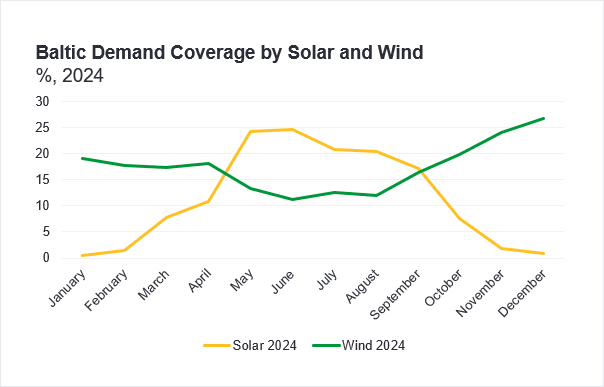
The share of fossil fuels fell to a record low
Generation at fossil-fuel power plants fell in August to its lowest level in a decade. Baltic fossil fuel-based electricity generation was about 162 GWh, 43% less than last year and three times lower than the five-year average. Fossil fuel-based electricity generation accounted for only 8.2% of total market demand. The same figure has averaged 33% in August during the years 2015–2024. The decline in generation was mainly driven by renewable energy and electricity imports, which covered demand during most hours and reduced the need for fossil-based production.
The number of hours with ultra-low prices doubled
In Estonia, 162 hours with very low prices (≤1 c/kWh) were recorded in August, more than double the figure for the same period last year. Daytime prices fell when solar and wind power were available, while evening prices remained higher. This created an opportunity for consumers on exchange prices to save significantly on electricity costs by shifting their consumption — for example, scheduling electric car charging, pre-heating with heat pumps or water heating to lower-priced hours.
Four key factors will shape September’s price
The arrival of autumn is characterised by the retreat of solar power and the increase of wind power. Days become shorter and cloudiness increases, reducing solar power generation. At the same time, wind power generation usually begins to increase in autumn, which helps to replace the reduced solar generation.
In addition, the price largely depends on the recovery of Nordic nuclear power plants. The scheduled maintenance of the plants will be completed by mid-September, which should reduce import prices and smooth out evening price peaks.
An unexpected factor affecting the electricity price is the disruption of the Estlink 1 interconnection, which reduces transmission capacity with the Finnish market. It is quite likely that this will mean higher-than-usual prices for Estonia and the Baltics.
Hydropower’s share has an important impact on limiting price peaks. If this production decreases, wind conditions remain weak, and import capacity is limited, prices may rise significantly, especially during evening peak hours.
Karl Joosep Randveer, Energy Trading Analyst at Eesti Energia
The market overview has been compiled by Eesti Energia according to the best current knowledge. The information provided is based on public information. The market overview is presented as informative material and not as a promise, proposal or official forecast by Eesti Energia. Due to rapid changes in the regulation of the electricity market, the market overview or the information contained in it is not final and may not correspond to future situations. Eesti Energia is not liable for any costs or damages that may arise in connection with the use of the information provided.