July electricity prices: The price difference between Estonia and Finland disappeared for 463 hours
- The price drop was significantly supported by high solar power generation across the Baltics, record-high hydropower production in Latvia and the restoration of the Estlink 2 interconnection to the market.
- Estonia’s electricity price was exactly at the same level as Finland’s for approximately two-thirds of the entire month of July. Electricity prices in Latvia and Lithuania were nearly a quarter higher than in Estonia due to maintenance work on the Estonia–Latvia interconnectors.
- In August, prices will primarily depend on solar production and import capacities. Price increases may be caused by cable maintenance works in the Nordics, as the resulting bottlenecks could prevent cheap Norwegian and Swedish hydropower from reaching Finland and subsequently, Estonia.
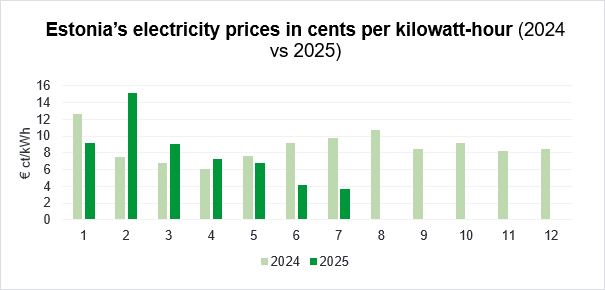
In July, electricity prices in Estonia fell by 11% compared to the previous month, with the average price reaching 3.7 cents per kilowatt-hour (€37 per megawatt-hour). Compared to July last year, when the average electricity price was 9.8 cents per kilowatt-hour, Estonia’s electricity price this year was approximately 63% lower.
The price decline, which has continued for the fifth month in a row, was significantly supported by strong solar power generation across the Baltics, continued above-average hydropower output in Latvia, and the restoration of the Estlink 2 interconnection.
Prices are lower this summer
This summer, prices are significantly lower compared to last summer. In June, the electricity price was 55% lower compared to last year, and in July, as mentioned earlier, 63% lower. When comparing this summer to last, two key factors play a major role in explaining a price difference more than twice as large between the two years.
One key factor is the restoration of the 650 MW Estlink 2 interconnection at the end of June this year, which resulted in identical electricity prices in Estonia and Finland for 463 hours – approximately 62% of the entire month of July. The large interconnection capacity with Finland provides the Baltics with access to both Nordic hydropower and nuclear energy from Finland. This helps to keep prices lower, especially during evening hours, compared to a situation where the interconnection was unavailable and, in the first case, gas-fired power plants in Latvia and Lithuania would need to be started up and in the latter case, Estonia’s expensive oil shale plants.
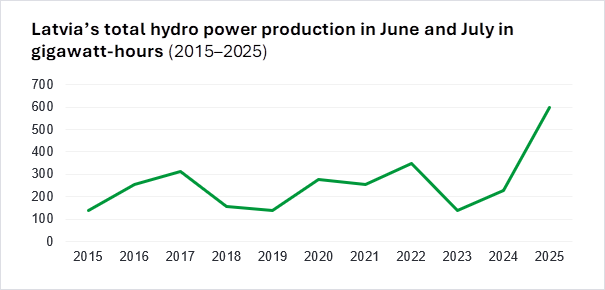
Another important factor, not seen in previous summer periods in the Baltics, is the unexpected increase in Latvia’s hydropower production. As of the end of July 2025, Latvia’s hydropower production has been the highest in the past ten years — nearly 2.7 times higher than the average of the last ten summers. The peak period of Latvian hydropower production, which usually occurs in spring, has this year helped to significantly lower evening prices in both June and July by primarily replacing evening output from gas-fired power plants.
It is also worth mentioning the consistent growth of wind and solar energy across the Baltics, which is helping to bring prices down below 5 cents per kilowatt-hour. On summer days, we are increasingly seeing hours where the electricity price falls below one cent per kilowatt-hour, primarily thanks to solar energy. As of the end of July, there have been a total of 541 such hours over the two summer months – nearly 37% of the entire summer period.
Maintenance work on the Latvia–Estonia interconnection kept Estonia’s electricity price below the Baltic average
During evening hours, electricity prices across the Baltics are influenced either by local fossil fuel-based electricity generation or by electricity imports from the Nordics. Due to maintenance work on the Estonia–Latvia cable, nearly 45% of the total interconnection capacity was out of service, hindering the transmission of imported electricity from Finland to Latvia and Lithuania. As a result, both Latvia and Lithuania had an average electricity price of 4.6 cents per kilowatt-hour, which is nearly 26% higher than the average price in Estonia.
For nearly one-third of July, Estonia’s electricity price was higher than Finland’s – by an average of 3.9 cents per kilowatt-hour. This price difference was most noticeable during peak hours between 18:00 and 21:00, when the average gap between the two countries reached 6.6 cents per kilowatt-hour. In Latvia and Lithuania, electricity prices matched those in Finland for only one-fifth of July. The average price difference with Finland was 3 cents per kilowatt-hour for both Latvia and Lithuania.
August electricity prices depend on solar and wind energy as well as imports from the Nordics
This month, electricity prices will heavily depend on solar and wind energy, as well as production and electricity prices in our northern neighbours. As August progresses, Latvian hydropower production is expected to decline, reducing the availability of affordable generation in the Baltics and increasing our reliance on more expensive gas and oil shale power plants.
Transmission capacity bottlenecks in the Swedish and Norwegian production zones may also drive up electricity prices in Estonia, as they limit the flow of cheap Swedish and Norwegian hydropower to Finland, thereby also hindering its transmission to the Baltics. This would lead to significant price increases, particularly during evening hours when there is a shortage of affordable electricity generation in the Baltics.
August weather forecasts indicate a mix of rain and sunshine. On sunny days, strong solar output helps keep electricity market prices lower, but when the sun disappears, generation is mainly taken over by fossil fuel-based plants in the Baltics and imports from our northern neighbours. As summer continues, solar energy will remain an important factor in lowering prices, but compared to July, August is expected to see a greater return of fossil fuel-based generation, which will in turn drive up local electricity prices.
Karl Joosep Randveer, Energy Trading Analyst at Eesti Energia
The market overview has been compiled by Eesti Energia according to the best current knowledge. The information provided is based on public information. The market overview is presented as informative material and not as a promise, proposal or official forecast by Eesti Energia. Due to rapid changes in the regulation of the electricity market, the market overview or the information contained in it is not final and may not correspond to future situations. Eesti Energia is not liable for any costs or damages that may arise in connection with the use of the information provided.