Energy Market Overview: Low Wind and Hydro Output Lifted June Power Prices
In June, the average electricity price in Estonia reached 6.51 cents per kilowatt-hour, up 8% compared to the previous month. The price also exceeded the level seen in June 2025, when the average stood at 4.13 cents per kilowatt-hour. The increase was driven mainly by lower wind generation and a reduced contribution from hydro power across the Baltics. At the same time, constrained transmission capacity between Estonia and Latvia kept Estonian power prices nearly one-third lower than those in neighboring Baltic countries.
While Estonian power prices have traditionally moved in line with those in Latvia and Lithuania, this is no longer the case. Estonia's average power price remained significantly lower than in Latvia (9.08 cents/kWh) and Lithuania (9.18 cents/kWh). This continues to be driven by limitations on the Estonia–Latvia interconnection, meaning that a larger share of lower-cost electricity imported from the Nordics remains in Estonia. It is worth recalling that in recent years all three Baltic states have generally traded at virtually the same price level.
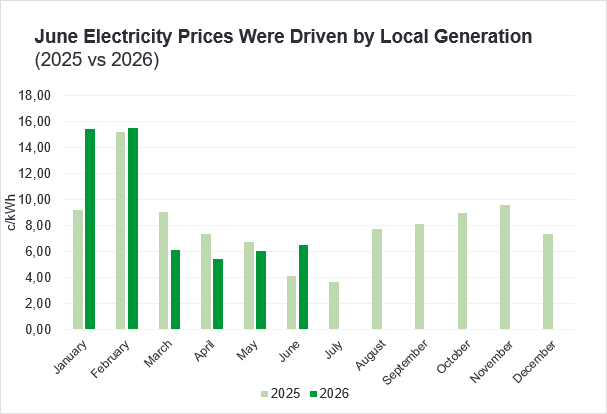
Rising prices were driven by a shortage of low-cost local generation
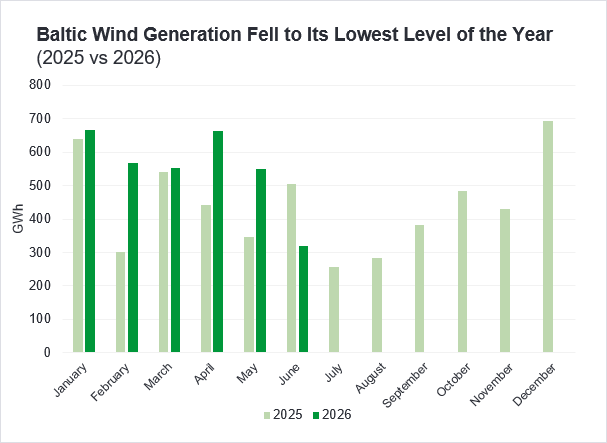
When comparing June 2026 with June 2025, the most notable difference can be seen in local power generation across the Baltics. First, Baltic wind generation fell by 42% compared to May, reaching 320 GWh in June. By comparison, wind output in June 2025 amounted to 505 GWh.
Second, the region benefited from nearly twice as much Latvian hydro generation last year, helping keep prices low even during evening hours. Hydro generation, together with wind power and low-cost imports, was sufficient to cover market demand without bringing more expensive generation assets online.
This June, however, prices remained higher because wind generation was insufficient precisely during the periods when solar output declined and import prices were not low enough to push regional prices down. As a result, more expensive generation units had to be dispatched, driving electricity prices higher during those periods.
Despite this, electricity prices in Estonia remain broadly in line with normal summer levels. Latvia and Lithuania, however, are once again experiencing conditions similar to those seen in the summer of 2024, when EstLink 2 was unavailable and regional power prices increased significantly.
Although renewable generation capacity has expanded rapidly across the Baltic region, it is still not sufficient to keep price levels stable on its own. During evening hours, when solar production fades and wind output is low, Estonia can typically rely on Finnish nuclear energy and Nordic hydro power imports. However, when these connections are unavailable, local fossil-fuel-based power plants must fill the gap, pushing prices well above 10 cents per kilowatt-hour.
This is exactly the situation that Estonia's southern neighbors are currently facing. The issue is likely to persist until additional competitively priced dispatchable generation capacity becomes available at the regional level.
July prices will depend on the same key drivers: wind and interconnection availability
In July, price dynamics will once again depend primarily on import availability and local wind and solar generation. Higher wind output across the Baltic region brings lower-cost electricity into the market and displaces more expensive generation assets, particularly during evening hours. Strong solar production during daytime hours also helps reduce prices across the region.
In addition, Baltic power futures are currently trading somewhat below June levels. Based on current market expectations, this suggests that electricity prices in July could be slightly lower than those seen in June.
Karl Joosep Randveer, Senior Market Analyst at Enefit
The market overview has been compiled by Enefit according to the best current knowledge. The information provided is based on public information. The market overview is presented as informative material and not as a promise, proposal or official forecast by Enefit. Due to rapid changes in the regulation of the electricity market, the market overview or the information contained in it is not final and may not correspond to future situations. Enefit is not liable for any costs or damages that may arise in connection with the use of the information provided.