Energy Market Overview: High Electricity Prices Reflect the Lack of Competitive Power Generation
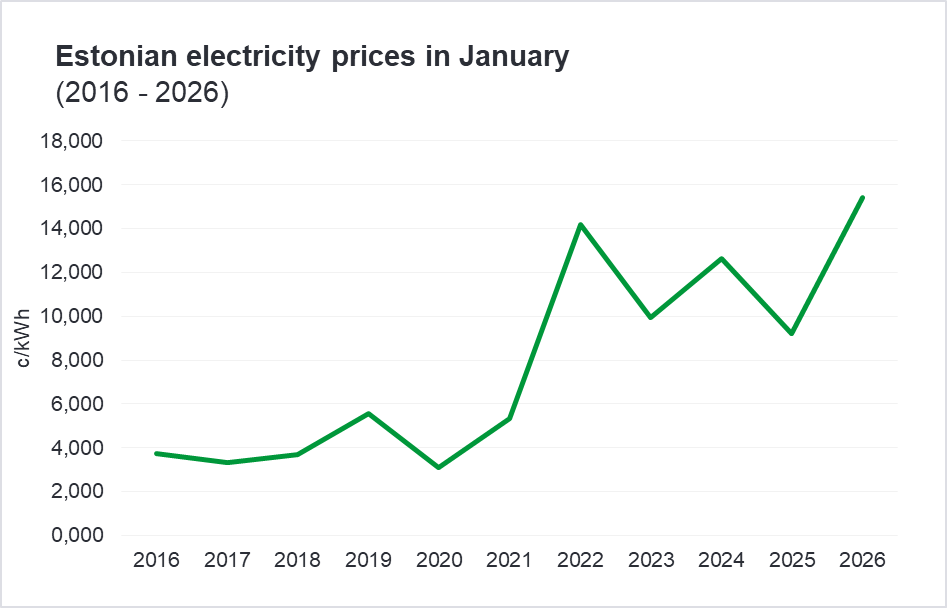
In January, electricity prices in Estonia were shaped by cold weather, snow, elevated demand, and wider regional pressures. The average monthly electricity price rose by 110% compared to December and reached 15.4 cents per kilowatt-hour. Compared to last year’s January, when the Estonian average electricity price was 9.2 cents per kilowatt-hour, this represents a 68% year-on-year increase. The most expensive January to date occurred at the start of the energy crisis in 2022, when the average price reached 14.4 cents per kilowatt-hour.
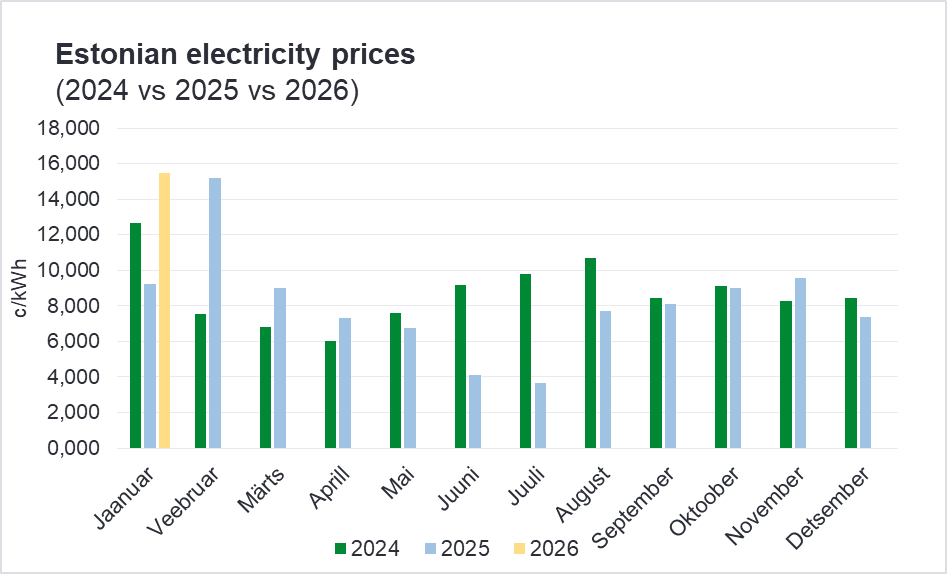
The coldest January in years increased demand and prices
According to the Estonian Environment Agency, January 2026 was one of the coldest of the past 25 years. Estonia’s average air temperature was –7.8°C (with the norm being –3.1°C), surpassed only by 2010, when the average temperature measured –11.4°C.
Due to the cold, Estonia’s electricity demand increased by nearly 20% in January compared to December. This rise is a significant price driver, as higher consumption requires additional production. However, the Baltic region lacks sufficient competitive electricity generation.
Despite seemingly modest wind conditions, wind energy still covered around one‑fifth of total Baltic consumption in January. Yet when favourable wind production cannot meet local demand and solar generation remains nearly non-existent in January, the system must rely on inefficient and expensive fossil-fuel-based plants.
Cold temperatures also heightened consumption in neighbouring countries, which in turn made imported electricity more expensive. Since imports from Finland are typically critical for lowering Estonia’s price level, Finnish production and consumption metrics play a major role in the Estonian electricity price. Compared to last year, Finland’s substantial wind fleet, challenged by low wind output and high demand, was unable to cover local consumption. As a result, Finland needed to import more electricity from its Nordic neighbours, significantly elevating regional price levels.
In addition, wind turbine icing—particularly in Finnish wind parks—caused production challenges. This led to situations where, even under suitable wind conditions, turbines were unable to generate electricity, preventing the long‑anticipated price drops.
Another impact on Estonian prices also came from the sharp decline in Latvia’s hydropower production compared to previous years. While in January 2025 Latvian hydropower covered around 16.5% of total Baltic demand, this January the figure was only about 7.1%.
Finally, more efficient oil shale units in Estonia were undergoing maintenance, forcing the region to rely more heavily on older and more expensive gas and oil shale plants — resulting in overall higher prices. Consequently, nearly 40% of the month’s hours in Estonia closed at prices exceeding 15 cents per kilowatt-hour.
How can consumers protect themselves?
High electricity prices are unpleasant for all electricity users. Inevitably, prices depend heavily on weather conditions — either through cold-driven demand increases or weather-dependent power generation. This volatility will continue in the future, as electricity markets rely increasingly on wind and solar power, which provide cheaper electricity. Periods of low renewable generation, however, must be compensated by dispatchable power plants, which bring higher prices to the market. This creates situations where wintertime off‑peak night prices remain fairly reasonable (for example 8–12 cents per kilowatt-hour), while prices during periods of high demand rise to around or above 20 cents per kilowatt-hour. To manage this price risk, consumers have two options.
First, consumers can choose to fix their electricity price. This creates predictability and reduces stress caused by extreme peak prices during the cold season. For example, in January, the average electricity price between 9:00 and 18:00 was approximately 20 cents per kilowatt-hour. If a customer had chosen to fix their price (for example at Enefit a year ago at 9.88 cents per kilowatt-hour + VAT), their costs would have been roughly twice lower.
Second, consumers can actively follow spot prices and shift higher‑load consumption to cheaper hours. Scheduling higher‑load activities (for example laundry or charging an EV) to hours when the price is nearly twice lower than the daily average can significantly influence the monthly bill. Smart devices and automated solutions also support efficient consumption. Nevertheless, it is important to keep in mind that if the entire month remains uniformly expensive, even well‑timed consumption will still lead to a higher bill.
What to expect next month?
As mentioned earlier, electricity market dynamics are primarily driven by weather conditions and the region’s production portfolio. Wind generation in the Baltics and Scandinavia, together with air temperatures, will remain key price drivers. Additionally, Latvian hydropower production influences Baltic prices, and in February, solar generation may begin to provide a modest positive impact during sunnier days.
Current forecasts point to continued cold conditions in the Baltic region, meaning demand is likely to remain high. This implies frequent shortages of low‑cost generation and a continued reliance on fossil‑based production, which sets higher prices. If wind production increases and/or temperatures ease, lower spot prices can be expected immediately. However, if cold weather persists alongside high consumption, the average monthly electricity price is likely to remain elevated.
Karl Joosep Randveer, Energy Trading Analyst at Enefit
The market overview has been compiled by Enefit according to the best current knowledge. The information provided is based on public information. The market overview is presented as informative material and not as a promise, proposal or official forecast by Enefit. Due to rapid changes in the regulation of the electricity market, the market overview or the information contained in it is not final and may not correspond to future situations. Enefit is not liable for any costs or damages that may arise in connection with the use of the information provided.