Energy market overview: The electricity price rose in September due to the decline in solar power and import restrictions
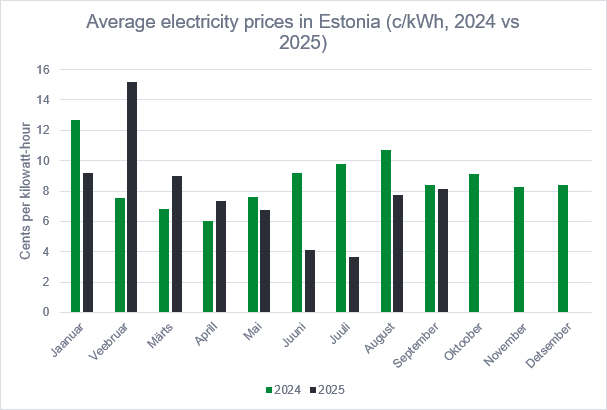
In September, the average electricity price in Estonia rose to 8.1 cents per kWh, which is nearly 5% higher than in August. Compared with the same period last year, the price remained virtually the same – in September 2024, the average price was 8.4 cents per kWh.
The price increase was driven by a combination of factors. Firstly, solar power generation across the Baltics fell by around 35% due to colder weather and shorter days. Secondly, the EstLink 1 interconnection (350 MW) between Finland and Estonia was out of service for most of the month, reducing import capacity from 1000 MW to 650 MW. In addition, Latvia’s hydropower output dropped by about 50% compared with August, following an exceptionally strong summer. As a result of these factors, the Baltic power system had to rely more heavily on domestic oil shale and other fossil fuel-based generation during peak demand periods, which also pushed electricity prices higher.
The share of fossil fuels nevertheless remained at a record low
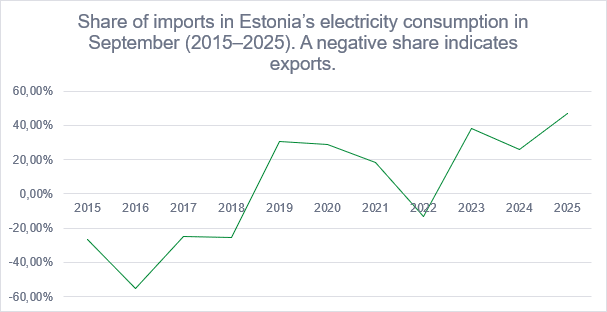
Despite the cooler weather, a large share of Estonia’s electricity consumption was covered by imports and renewable energy. Imported electricity accounted for 47% of Estonia’s consumption (54% in August), the highest September level in the past ten years. Solar and wind power together made up about one-third of total consumption, electricity generated from oil shale accounted for nearly 10%, and the remainder was produced from retort gas, biomass, and smaller generation sources.
In September, 311 GWh of electricity was produced in Estonia, which was also the lowest September figure in the past ten years. At the same time, electricity generation was 20% higher than in August but 20% lower than in September 2024.
Although EstLink 1 was out of service for much of September (as was EstLink 2 at the beginning of September 2024), import conditions were nevertheless better this year due to the Nordic countries’ higher export capacity. This provided better access to Nordic electricity and increased imports.
Which power plants set the electricity price?
The electricity price in the market is determined by the last supplier who offers the remaining required amount of energy. When the price is around 6–7 cents per kWh, the price setters are often solar, wind, or imported Nordic energy. When the price rises to around €100/MWh, the last accepted bid in the Baltics is usually from a gas-fired power plant. When the price exceeds €150/MWh, the price is often set by Estonia’s oil shale power plants.
Excluding peak consumption hours and assuming the interconnection capacities are fully operational, cheaper renewable energy – Nordic hydro, Estonian and Lithuanian wind and solar, and Latvian hydro – quickly meets the Baltic demand. Under such conditions, fossil-fuel-based power plants cannot remain competitive.
Price differences are decreasing – Estonia’s electricity price remained at the same level as Finland’s for one-third of September
In September, Estonia’s electricity price moved closely in line with the prices in Finland and southern Sweden. Exactly the same price as in Finland occurred during 29.3% of the hours in September. Excluding price differences of up to 0.1 €/MWh, the price matched Finland’s for 33.1% of the hours and southern Sweden’s for 5% of the hours. Looking at the hours when the price difference was less than €1/MWh, the overlap was 35.7% of the hours with Finland and 16.9% with Sweden.
Looking at the Baltics, Estonia’s price moved almost identically to those in Latvia and Lithuania. Exactly the same price was maintained with Latvia for 80% of the hours and with Lithuania for 78.9% of the hours. This shows that the Baltic price areas operate, in the absence of interconnection failures, essentially as one system – at one time the electricity price depends on the last wind turbine in southern Sweden, at another on oil shale in Narva, at another on Lithuania’s gas-fired power plants.
In September, Estonia’s electricity price moved closely in line with the prices in Finland and southern Sweden. Exactly the same price as in Finland occurred during 29.3% of the hours in September. When price differences of up to 0.1 c/kWh are excluded, the price matched Finland’s for 35.7% of the hours and southern Sweden’s for almost 17%. Looking at the hours when the price difference was less than 1 c/kWh, the overlap increased to 52% with southern Sweden and to 45% with Finland. This clearly shows that Estonia’s electricity prices are influenced primarily by the Finnish and southern Swedish price areas through the EstLink interconnections, as well as via the Lithuania–Sweden NordBalt interconnection.
Large intraday price fluctuations support the profitability of battery storage
In September, the Baltics experienced unusually large intraday price fluctuations. On several days, price differences reached 80–150 euros per MWh. This created significant earning opportunities for batteries that were able to charge from the network during low-price hours and discharge during high-price hours.
However, deploying batteries across other energy markets further increases their revenues. For example, a battery with a capacity of 1 MW and 2 MWh could have earned up to €14,000 on the day-ahead market in September. At the same time, the same battery participating across all market segments (aFRR, mFRR, FCR, intraday, and day-ahead) could have earned up to €79,000, based on Enefit’s trading strategies.
October brings a seasonal change
At the end of September, we already saw early-winter conditions – shorter days and cold mornings. In October, heating demand increases, which further increases electricity consumption. At the same time, the share of solar energy is gradually decreasing. Prices therefore depend primarily on wind conditions and the Nordic countries’ export capacity. Windy and warmer days also bring lower electricity prices. On calm and colder days, oil-shale or gas-fired power plants have to respond to meet demand, and electricity prices rise. The EstLink 2 maintenance at the end of October and the Lithuania–Sweden interconnection maintenance at the beginning of the month may also raise prices.
Karl Joosep Randveer, Energy Trading Analyst at Eesti Energia
The market overview has been compiled by Eesti Energia according to the best current knowledge. The information provided is based on public information. The market overview is presented as informative material and not as a promise, proposal or official forecast by Eesti Energia. Due to rapid changes in the regulation of the electricity market, the market overview or the information contained in it is not final and may not correspond to future situations. Eesti Energia is not liable for any costs or damages that may arise in connection with the use of the information provided.